Introduction
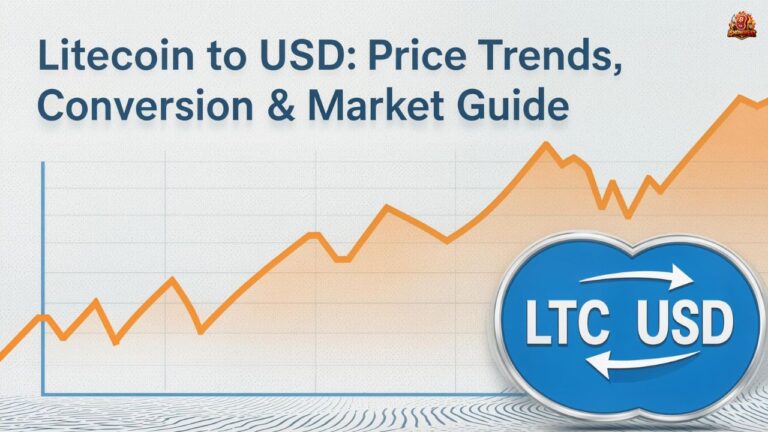
Crypto prices can change in seconds. One moment Litecoin is climbing steadily, and the next, traders are scrambling to understand what caused a sudden dip. That constant movement is exactly why searches for litecoin to usd continue growing among investors, traders, and everyday crypto users.
Whether someone wants to cash out profits, track market trends, or simply understand Litecoin’s value in US dollars, the LTC/USD pair has become one of the most closely watched indicators in the altcoin market. And honestly, it makes sense. Litecoin has survived multiple crypto cycles while hundreds of other coins disappeared completely.

For beginners, the Litecoin market can feel overwhelming at first. Prices move quickly, trading terms sound confusing, and predictions often conflict with each other. However, once you understand how Litecoin pricing works, what affects the exchange rate, and how traders approach the market, things become much clearer.
This guide breaks down everything you need to know about Litecoin to USD conversions, price history, market influences, trading strategies, risks, and Litecoin’s future role in digital finance.
Table of Contents
What Is Litecoin?
Understanding Litecoin to USD
How Litecoin Prices Are Determined
Historical Performance of Litecoin
Why Traders Monitor Litecoin to USD
Factors That Affect Litecoin Prices
Litecoin vs Bitcoin: Key Differences
How to Convert Litecoin to USD
Litecoin Founder, Background, and Financial Growth
Risks of Trading Litecoin
Future Predictions for Litecoin
FAQ
Conclusion
What Is Litecoin?
Litecoin is a decentralized cryptocurrency created in 2011 by Charlie Lee. It was designed as a faster and lighter alternative to Bitcoin.
Charlie Lee launched Litecoin to improve several aspects of early cryptocurrency transactions, particularly speed and transaction efficiency.
While Bitcoin became known as “digital gold,” Litecoin earned a reputation as “digital silver.”
Key Features of Litecoin
Litecoin introduced several technical differences compared to Bitcoin:
| Feature | Litecoin | Bitcoin |
|---|---|---|
| Launch Year | 2011 | 2009 |
| Block Time | 2.5 minutes | 10 minutes |
| Maximum Supply | 84 million LTC | 21 million BTC |
| Algorithm | Scrypt | SHA-256 |
These changes allowed Litecoin transactions to process faster and often at lower fees.
Why Litecoin Still Matters
Many cryptocurrencies disappear after hype fades. Litecoin survived because it developed a loyal community and practical payment utility.
Today, Litecoin remains widely available across:
- Major exchanges
- Crypto payment platforms
- Digital wallets
- Trading markets
- Merchant payment systems
Its longevity gives many investors confidence compared to newer speculative altcoins.
Understanding Litecoin to USD
The phrase litecoin to usd refers to the exchange rate between Litecoin (LTC) and the US dollar (USD).
In simple terms:
- If Litecoin trades at $100, then 1 LTC = 100 USD.
- If Litecoin rises to $150, the value increases accordingly.
This exchange rate constantly changes because crypto markets operate 24/7.
Why the LTC/USD Pair Is Important
The US dollar remains the dominant global currency. Because of that, most crypto traders measure asset performance against USD.
Monitoring Litecoin to USD helps investors:
- Evaluate profits and losses
- Track market momentum
- Compare Litecoin with other cryptocurrencies
- Identify buying opportunities
- Analyze broader crypto sentiment
Real-Life Example
Imagine buying 10 LTC at $70 each.
Your total investment:
- 10 × $70 = $700
If Litecoin later rises to $120:
- 10 × $120 = $1,200
Potential gain:
- $500 before fees or taxes
This simple example explains why price movements matter so much to traders.
How Litecoin Prices Are Determined
Many beginners assume crypto prices are controlled by companies or governments. In reality, Litecoin prices are driven mainly by market supply and demand.
Market Supply and Demand
If more people want to buy Litecoin than sell it, prices typically rise.
If selling pressure increases, prices usually fall.
This happens across crypto exchanges worldwide every second.
Trading Volume
Trading volume measures how much Litecoin changes hands within a certain timeframe.
Higher volume often means:
- Stronger market interest
- Greater liquidity
- More stable price discovery
Low volume can create sharper price swings.
Investor Sentiment
Emotions heavily influence crypto markets.
Positive sentiment may come from:
- Bull markets
- Institutional adoption
- Favorable regulations
- Market optimism
Negative sentiment may result from:
- Hacks
- Economic fears
- Regulatory crackdowns
- Market crashes
Crypto markets often react emotionally faster than traditional financial markets.
Historical Performance of Litecoin
Litecoin has experienced extreme highs and painful crashes throughout its history.
Early Growth Years
During its early years, Litecoin traded for only a few dollars. Many investors saw it as a testing ground for Bitcoin-like technology.
As crypto adoption increased, Litecoin gained visibility rapidly.
Major Bull Runs
Litecoin exploded during major crypto bull markets.
Notable periods include:
- 2017 crypto boom
- 2021 market rally
At peak moments, Litecoin reached prices far beyond early expectations.
However, rapid gains often came with brutal corrections afterward.
Bear Market Declines
Crypto winters affected Litecoin significantly.
Like most digital assets, LTC experienced:
- Sharp volatility
- Declining trading volume
- Reduced investor enthusiasm
Still, Litecoin repeatedly recovered better than many smaller projects that vanished entirely.
Why Traders Monitor Litecoin to USD
Professional and retail traders closely watch Litecoin pricing for several reasons.
Short-Term Trading Opportunities
Litecoin volatility creates opportunities for active traders.
Popular strategies include:
- Day trading
- Swing trading
- Scalping
- Momentum trading
Even small price fluctuations can produce gains or losses quickly.
Market Sentiment Indicator
Litecoin sometimes reflects broader altcoin market sentiment.
When Litecoin rallies strongly, traders may interpret it as:
- Increased risk appetite
- Altcoin market momentum
- Renewed retail interest
Portfolio Diversification
Some investors hold Litecoin alongside:
- Bitcoin
- Ethereum
- Stablecoins
- Traditional investments
Diversification can reduce exposure to a single asset.
However, crypto markets often move together during extreme volatility.
Factors That Affect Litecoin Prices
Litecoin prices don’t move randomly. Several major factors influence market behavior.
Bitcoin Market Influence
Bitcoin remains the dominant cryptocurrency.
When Bitcoin rises sharply:
- Litecoin often follows upward.
When Bitcoin crashes:
- Litecoin frequently drops too.
Bitcoin still shapes overall market psychology.
Regulations
Government regulations strongly impact crypto prices.
Positive developments:
- ETF approvals
- Clear legal frameworks
- Institutional access
Negative developments:
- Trading bans
- Tax crackdowns
- Regulatory uncertainty
Markets react extremely fast to legal headlines.
Adoption and Utility
Litecoin adoption matters long term.
Factors include:
- Merchant payments
- Wallet integrations
- Exchange listings
- Payment processor support
The more practical use Litecoin has, the stronger its long-term foundation may become.
Macroeconomic Conditions
Interest rates, inflation, and global financial uncertainty also affect crypto markets.

For example:
- Inflation fears sometimes push investors toward digital assets.
- Rising interest rates may reduce speculative investment appetite.
Crypto no longer exists completely outside traditional finance.
Litecoin vs Bitcoin: Key Differences
Many people compare Litecoin directly to Bitcoin because of their similar origins.
Transaction Speed
Litecoin transactions process faster than Bitcoin transactions on average.
This makes Litecoin more practical for smaller everyday transfers.
Supply Limits
Litecoin’s maximum supply is four times larger than Bitcoin’s.
- Litecoin: 84 million coins
- Bitcoin: 21 million coins
This affects scarcity narratives and long-term valuation discussions.
Market Position
Bitcoin dominates institutional adoption and media attention.
Litecoin, however, often appeals to users seeking:
- Lower fees
- Faster transfers
- Simpler payment utility
Both assets serve slightly different market roles.
How to Convert Litecoin to USD
Converting Litecoin into US dollars has become relatively simple compared to crypto’s early days.

Using Crypto Exchanges
Most users convert Litecoin through exchanges.
Typical steps:
- Deposit Litecoin
- Sell LTC for USD
- Withdraw dollars to a bank account
Popular exchanges usually provide live market pricing.
Peer-to-Peer Transfers
Some users exchange Litecoin directly with buyers.
However, peer-to-peer trading introduces higher fraud risks if done carelessly.
Conversion Fees
Important costs include:
- Trading fees
- Withdrawal fees
- Blockchain transaction fees
- Spread differences
These small charges can affect profitability more than beginners expect.
Litecoin Founder, Background, and Financial Growth
Charlie Lee’s Background

Charlie Lee worked as a software engineer before launching Litecoin.
His technical background helped him improve upon existing cryptocurrency concepts while maintaining simplicity.
Litecoin’s Career Journey
Litecoin quickly became one of the earliest successful Bitcoin alternatives.
Over time, it achieved:
- Major exchange listings
- Merchant adoption
- Payment integrations
- Strong community development
Even after newer cryptocurrencies appeared, Litecoin maintained relevance.
Financial and Market Insights
Litecoin consistently ranks among recognized cryptocurrencies by market capitalization.
Its value fluctuates heavily based on:
- Crypto market cycles
- Investor demand
- Trading volume
- Global adoption trends
Although Litecoin no longer dominates headlines like Bitcoin, its survival through multiple cycles remains one of its biggest strengths.

Risks of Trading Litecoin
Crypto investing always involves substantial risk.
Volatility Risk
Litecoin prices can change dramatically within hours.
Large swings may create:
- Fast profits
- Severe losses
- Emotional trading mistakes
Many beginners underestimate how stressful volatility can feel in real time.
Security Risks
Crypto holders face security threats including:
- Phishing attacks
- Exchange hacks
- Fake wallet apps
- Scam investment schemes
Proper wallet security matters enormously.
Regulatory Uncertainty
Governments worldwide still debate cryptocurrency regulations.
Future laws could impact:
- Trading access
- Tax treatment
- Exchange operations
- Market sentiment
Regulation remains one of crypto’s biggest uncertainty factors.
Emotional Investing
Fear and greed dominate many crypto decisions.
Common mistakes include:
- Buying during hype
- Panic selling during crashes
- Overtrading
- Ignoring risk management
Successful investors usually rely more on discipline than excitement.
Future Predictions for Litecoin
Predicting cryptocurrency prices perfectly is impossible. Still, analysts continue debating Litecoin’s long-term future.
Bullish Arguments
Supporters believe Litecoin benefits from:
- Long market history
- Strong liquidity
- Established exchange support
- Payment utility
- Brand recognition
Some investors see Litecoin as undervalued compared to newer hype-driven coins.
Bearish Concerns
Critics argue Litecoin faces increasing competition from:
- Faster blockchains
- Stablecoins
- Layer-2 payment systems
- Modern smart contract ecosystems
Innovation speed matters heavily in crypto.
Potential Long-Term Role
Litecoin may continue functioning as:
- A payment-focused cryptocurrency
- A lower-cost Bitcoin alternative
- A liquidity asset across exchanges
Its future likely depends on maintaining practical utility rather than speculative hype alone.

FAQ
What does litecoin to usd mean?
It refers to the exchange rate between Litecoin (LTC) and the US dollar (USD).
Is Litecoin still a good investment?
That depends on individual risk tolerance and market conditions. Litecoin remains one of the oldest and most established cryptocurrencies.
Why does Litecoin price change so fast?
Crypto markets operate 24/7 and react quickly to supply, demand, investor sentiment, regulations, and Bitcoin price movements.
How can I convert Litecoin to USD?
You can usually convert Litecoin through cryptocurrency exchanges by selling LTC for US dollars.
Is Litecoin faster than Bitcoin?
Yes. Litecoin transactions generally confirm faster due to shorter block times.
Who created Litecoin?
Litecoin was created by Charlie Lee, a former Google engineer, in 2011.
Can Litecoin reach previous highs again?
No one can predict future prices with certainty. Crypto markets remain highly volatile and speculative.
Are Litecoin transactions expensive?
Compared to some cryptocurrencies, Litecoin transactions are often relatively low cost.
Is Litecoin safe to use?
The Litecoin blockchain itself is considered secure, but users must still protect wallets, passwords, and exchange accounts carefully.
Conclusion
Litecoin has survived longer than many people expected, and that alone says something important about its resilience in the constantly changing crypto industry. While newer projects often chase trends and hype cycles, Litecoin continues maintaining a reputation for speed, simplicity, and reliability.
Understanding litecoin to usd pricing isn’t only about watching charts or chasing profits. It’s also about learning how crypto markets behave, how investor psychology shapes volatility, and how digital assets fit into modern finance.
For some people, Litecoin represents a practical payment cryptocurrency. For others, it’s a speculative investment or diversification tool. Either way, approaching the market with patience, realistic expectations, and proper risk management will always matter more than short-term excitement.