
Introduction
For years, crypto was criticized for being disconnected from the “real world.” People understood Bitcoin and blockchain technology, but many still wondered how digital tokens could connect to actual businesses, real estate, bonds, or physical assets. That’s exactly where the question what is rwa becomes incredibly important.
RWA stands for “Real World Assets,” and it’s quickly becoming one of the most talked-about sectors in blockchain finance. Instead of creating tokens backed only by speculation, RWA projects aim to connect blockchain technology with tangible assets that already exist outside crypto markets.
In simple terms, RWA tokenization allows things like real estate, government bonds, invoices, commodities, or even art collections to be represented digitally on a blockchain. Supporters believe this could unlock trillions of dollars in liquidity and reshape modern investing.
At the same time, skeptics argue that regulation, legal complexity, and centralized custody risks could slow adoption dramatically. So, is RWA truly the future of finance—or just another crypto buzzword?
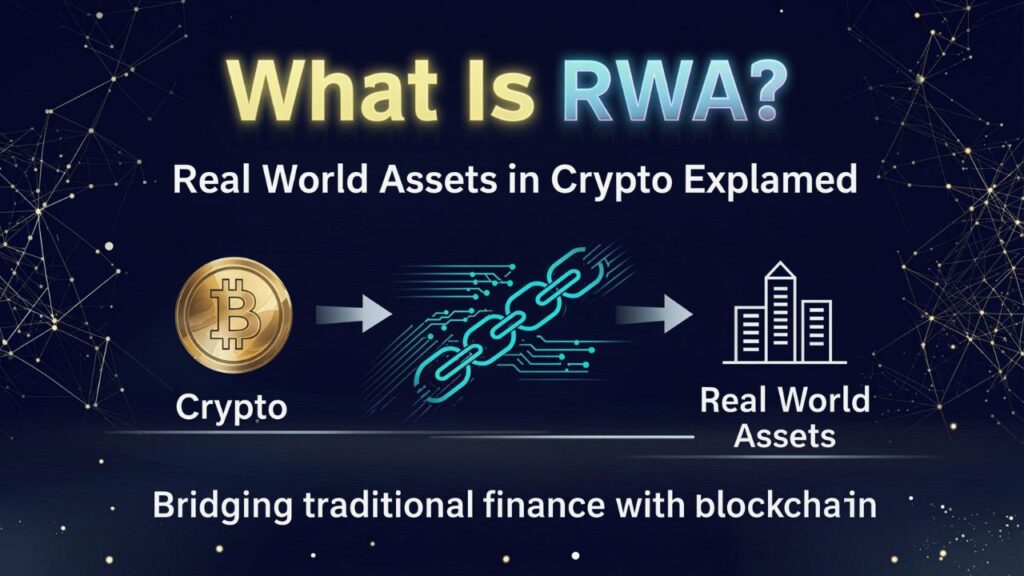
This guide explains everything in plain language, including how RWAs work, why institutions are paying attention, the risks involved, and what this trend could mean for the future of global markets.
Table of Contents
What Is RWA in Crypto?
How Real World Asset Tokenization Works
Why RWAs Matter in Blockchain Finance
Types of Real World Assets in Crypto
Benefits of RWA Tokenization
Risks and Challenges of RWAs
Major Companies and Projects in the RWA Sector
Institutional Interest in RWAs
RWA Market Growth and Financial Potential
The Future of Real World Assets
FAQ
Conclusion
What Is RWA in Crypto?
The phrase what is rwa refers to the process of bringing real-world financial or physical assets onto blockchain networks through tokenization.
A tokenized asset is essentially a digital representation of ownership or value connected to something outside the blockchain.
Examples include:
- Real estate properties
- Government bonds
- Stocks
- Commodities like gold
- Private credit
- Art collections
- Luxury goods
Instead of relying entirely on speculative cryptocurrencies, RWAs aim to connect blockchain technology with existing financial systems.
Simple Explanation of RWAs
Imagine owning a commercial building worth $10 million.
Traditionally, investing in that property would require:
- Large amounts of capital
- Legal paperwork
- Banks or brokers
- Limited liquidity
With tokenization, ownership could potentially be divided into thousands of blockchain-based tokens. Investors might buy small fractions of the property digitally.
That idea is one of the core reasons the RWA sector has gained massive attention.
Why the Crypto Industry Became Interested in RWAs
The decentralized finance industry initially focused heavily on purely crypto-native assets.
However, many investors realized:
- Real-world assets have existing value
- Traditional finance is enormous
- Blockchain technology improves accessibility
- Tokenization may increase efficiency
This created strong momentum around RWAs as a bridge between traditional finance and Web3.
How Real World Asset Tokenization Works
Understanding tokenization sounds complicated at first, but the basic process is surprisingly logical.
Step 1: Identify the Real Asset
An asset owner chooses something valuable to tokenize.
This could include:
- Property
- Bonds
- Debt instruments
- Precious metals
- Revenue streams
Step 2: Legal Structuring
This is one of the most important steps.
Legal agreements define:
- Ownership rights
- Investor protections
- Regulatory compliance
- Revenue distribution
Without legal clarity, tokenization becomes risky.
Step 3: Create Blockchain Tokens
Digital tokens are issued on a blockchain network.
These tokens may represent:
- Equity ownership
- Revenue rights
- Debt claims
- Fractional shares
Step 4: Investors Purchase Tokens
Investors buy tokens through blockchain platforms or marketplaces.
This creates new liquidity opportunities compared to traditional markets.
Why RWAs Matter in Blockchain Finance
The RWA narrative became powerful because it addresses one of crypto’s biggest criticisms: lack of connection to real economic activity.
Bridging Traditional Finance and Crypto
Traditional finance manages enormous amounts of capital globally.
By comparison, crypto markets remain relatively small.
RWAs potentially connect blockchain infrastructure with:
- Banking systems
- Real estate markets
- Credit markets
- Institutional investing
This bridge could dramatically expand blockchain adoption.
Improving Liquidity
Many real-world assets are difficult to trade quickly.
For example:
- Selling property can take months
- Private investments often lock capital for years
- Fine art markets are highly illiquid
Tokenization may allow faster transfers and fractional ownership.
Global Accessibility
One exciting aspect of RWAs is broader accessibility.
In theory, investors worldwide could gain exposure to assets previously reserved for:
- Wealthy individuals
- Institutions
- Accredited investors
This could democratize certain investment opportunities.
Types of Real World Assets in Crypto
Not all RWA projects focus on the same asset classes.

Real Estate Tokenization
Real estate remains one of the most popular RWA sectors.
Benefits may include:
- Fractional ownership
- Rental income distribution
- Increased liquidity
- Lower investment barriers
Instead of buying an entire property, investors might own small digital shares.
Treasury and Bond Tokenization
Government bonds and treasury products have become increasingly important within decentralized finance.
Some blockchain protocols now offer tokenized treasury exposure.
This attracts investors seeking:
- More stable yields
- Lower volatility
- Traditional financial backing
Commodity Tokenization
Physical assets like gold can also be tokenized.
This allows investors to:
- Trade digital representations
- Avoid physical storage issues
- Access commodities globally
Gold-backed tokens became especially popular during periods of economic uncertainty.
Private Credit and Loans
Private credit markets are another fast-growing RWA category.
Blockchain-based lending systems may improve:
- Transparency
- Settlement efficiency
- Accessibility
This sector attracted substantial institutional attention recently.
Benefits of RWA Tokenization
The excitement around RWAs isn’t just marketing hype. The model offers several real advantages.
Fractional Ownership
Traditional investing often requires significant capital.
Tokenization allows assets to be split into smaller portions, making investing more accessible.
Example:
- Instead of buying an entire apartment building, an investor buys a small tokenized share.
Faster Settlement
Traditional finance can involve:
- Delays
- Multiple intermediaries
- Complex paperwork
Blockchain settlement may improve transaction efficiency significantly.
Transparency
Blockchain systems create public transaction records.
This may improve:
- Auditability
- Ownership verification
- Transfer tracking
Transparency is one of blockchain’s strongest advantages.
Potentially Lower Costs
Reducing intermediaries could lower:
- Administrative expenses
- Brokerage costs
- Settlement fees
However, legal and compliance costs still remain significant.
Risks and Challenges of RWAs
Despite huge optimism, the RWA sector faces serious obstacles.
Regulatory Complexity
Regulation remains the biggest challenge.
Real-world assets involve:
- Securities laws
- Property rights
- International compliance
- Tax obligations
Different countries may apply different legal frameworks.
Centralization Risks
Ironically, many RWA systems rely heavily on centralized entities.
For example:
- Custodians
- Legal companies
- Asset managers
If these entities fail, investors may face major risks.
Liquidity Challenges
Some tokenized assets still struggle with low trading activity.
Without active markets:
- Selling becomes difficult
- Pricing may become unstable
- Investors may face delays
Liquidity remains essential for long-term success.
Valuation Concerns
Determining accurate prices for real-world assets can be difficult.
This becomes especially challenging for:
- Private assets
- Rare collectibles
- Illiquid investments
Poor valuation methods may create investor risks.
Major Companies and Projects in the RWA Sector
Several major players now compete within the RWA ecosystem.
Blockchain Projects Focused on RWAs
Popular blockchain ecosystems exploring RWAs include:
- Ethereum
- Polygon
- Avalanche
- Stellar
These networks support tokenization infrastructure and smart contracts.
Institutional Asset Managers
Traditional finance giants increasingly explore tokenized finance.
Companies such as:
- BlackRock
- Franklin Templeton
have shown interest in blockchain-based financial products.
This institutional involvement dramatically increased market credibility.
Crypto-Native RWA Platforms
Several blockchain-native projects specialize specifically in RWAs.
These platforms focus on:
- Real estate
- Credit markets
- Treasury products
- Yield generation
Competition in this sector continues intensifying rapidly.

Institutional Interest in RWAs
One reason the RWA sector gained momentum is institutional participation.
Why Institutions Care About RWAs
Large financial firms see several potential advantages:
- Faster settlement systems
- Increased efficiency
- New liquidity opportunities
- Global asset accessibility
Traditional finance moves slowly, and blockchain may modernize infrastructure.
Tokenization of Traditional Markets
Supporters believe tokenization could eventually affect:
- Stocks
- Bonds
- Real estate
- Carbon credits
- Intellectual property
Some analysts compare this transition to the early internet transforming communication.
Financial Industry Transformation
If tokenization expands successfully, financial markets may become:
- More programmable
- More accessible
- Faster to settle
- More transparent
However, adoption will likely happen gradually rather than overnight.
RWA Market Growth and Financial Potential
The financial potential of RWAs is enormous because traditional markets are massive.
Trillion-Dollar Opportunity
Global real estate alone represents trillions of dollars in value.
Other huge markets include:
- Government debt
- Corporate bonds
- Commodities
- Private credit
Even small blockchain penetration into these sectors could create massive growth.
Growing Investor Interest
Investors increasingly search for:
- Stable yield opportunities
- Lower-volatility crypto sectors
- Real economic utility
RWAs appear attractive because they connect digital finance with tangible assets.
Market Sentiment Shift
Crypto narratives constantly evolve.
Earlier cycles focused heavily on:
- Meme coins
- NFTs
- Speculative DeFi tokens
RWAs introduced a more financially grounded narrative tied to real economic activity.
The Future of Real World Assets
The future of RWAs could become one of the most important developments in blockchain history.
Integration With Traditional Finance
Rather than replacing traditional finance completely, blockchain may integrate with it.
Future systems may combine:
- Banks
- Tokenized assets
- Smart contracts
- Digital settlement systems
This hybrid model appears increasingly realistic.
Expansion of Tokenized Investing
In the future, investors may eventually buy tokenized:
- Homes
- Stocks
- Infrastructure projects
- Art collections
- Revenue streams
This could reshape ownership structures globally.
Challenges Still Ahead
Despite optimism, several barriers remain:
- Regulatory uncertainty
- Legal enforcement
- Technology scalability
- Security concerns
- Market adoption
Mass adoption will likely require years of infrastructure development.
Why RWAs Are Different From Past Crypto Trends
Unlike purely speculative crypto narratives, RWAs connect directly to existing economic systems.
That practical utility explains why:
- Institutions care
- Governments are watching
- Investors remain interested
The long-term potential may ultimately depend on execution rather than hype.
FAQ
What is RWA in crypto?
RWA stands for Real World Assets. It refers to tokenizing physical or traditional financial assets on blockchain networks.
Why are RWAs important?
RWAs connect blockchain technology with real economic assets like real estate, bonds, and commodities, potentially improving liquidity and accessibility.
Can real estate be tokenized?
Yes. Real estate tokenization allows ownership shares of properties to be represented digitally through blockchain tokens.
Are RWAs safe investments?
RWAs still carry risks including regulation, liquidity issues, valuation concerns, and centralized custody risks.
What assets can become tokenized?
Examples include:
- Real estate
- Bonds
- Gold
- Credit markets
- Art
- Stocks
Why are institutions interested in RWAs?
Institutions see potential efficiency improvements, faster settlements, and new investment opportunities through tokenized finance.
Which blockchains support RWAs?
Ethereum, Polygon, Avalanche, and Stellar are among the major networks supporting RWA projects.
Could RWAs replace traditional finance?
More likely, blockchain and traditional finance may gradually integrate rather than fully replace each other.
Are RWAs regulated?
Regulation varies by country and asset type. Legal compliance remains one of the sector’s biggest challenges.
Conclusion
Understanding what is rwa is becoming increasingly important because real-world asset tokenization may represent one of blockchain’s most practical and transformative use cases. Instead of existing purely inside speculative crypto ecosystems, RWAs connect blockchain technology with tangible economic value.
That shift matters. Investors, institutions, and even governments are paying attention because tokenization has the potential to modernize how ownership, investing, and financial settlement work globally.
At the same time, the road ahead won’t be simple. Legal frameworks, regulation, liquidity, and infrastructure still need significant development. But if the industry successfully solves these challenges, RWAs could become one of the strongest bridges between traditional finance and the future of Web3.