
The dream sounds almost unreal: the same reaction that powers the Sun, controlled here on Earth, producing enormous energy without carbon emissions from the reaction itself. That is why the fusion reactor has become one of the most watched ideas in clean energy.
For decades, it carried a running joke: fusion was always “30 years away.” That joke is getting harder to use. Recent experiments, private investment, stronger magnets, better lasers, and serious international programs have pushed fusion energy from distant science fiction into a difficult but increasingly real engineering race.
Still, the story needs honesty. A working lab result is not the same as a reliable power plant. A fusion power station must run repeatedly, safely, economically, and long enough to matter on the grid. That gap is where the real challenge lives.
If you’ve searched what is fusion, how does nuclear fusion work, fusion energy breakthrough, or the latest fusion energy news, this guide will help you understand what’s exciting, what’s misunderstood, and what still has to be solved.
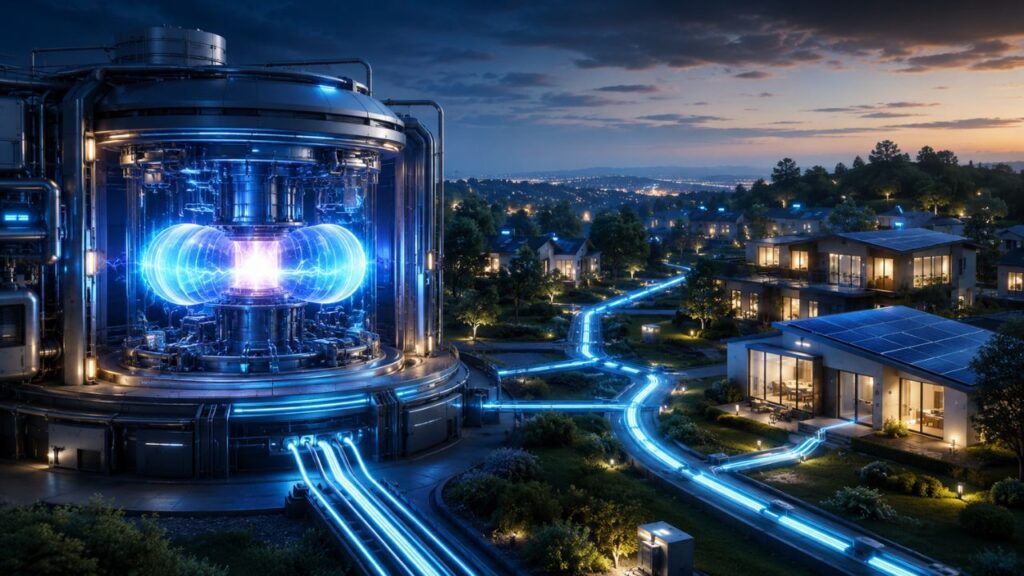
What Is a Fusion Reactor?
A fusion reactor is a machine designed to create and control fusion reactions so their energy can eventually be converted into usable heat and electricity. Unlike a conventional nuclear fission plant, which splits heavy atoms, fusion joins light atomic nuclei together.
The basic idea is simple. Force light atoms close enough together, let them merge, and the reaction releases energy because a tiny amount of mass changes into energy. The physics comes from Einstein’s famous mass-energy relationship, and the U.S. Department of Energy explains that fusion powers the Sun and other stars by merging light nuclei into heavier ones.
That sounds clean and elegant. The engineering is anything but easy.
Why Fusion Is So Hard to Control
Atoms do not want to fuse naturally on Earth. Their positively charged nuclei repel each other, so scientists must create extreme conditions to overcome that repulsion.
The International Atomic Energy Agency explains that fusion requires nuclei to collide at very high temperatures, and the reaction happens in plasma, a hot charged gas made of ions and free electrons. That plasma can reach temperatures far hotter than the core of the Sun.
A nuclear fusion reactor must do several things at once:
- Heat fuel to extreme temperatures
- Keep plasma stable
- Prevent hot plasma from touching machine walls
- Capture released energy
- Handle neutron damage
- Breed or supply tritium fuel
- Operate reliably, not just briefly
That is why fusion research is not one problem. It is a stack of physics, materials science, robotics, superconducting magnets, lasers, fuel systems, and power-plant engineering.
The Main Goal
The goal is not simply to create fusion. Scientists already do that in experiments.
The goal is useful fusion power: more usable energy out than all the energy and cost required to operate the full plant. That means the power plant must do more than impress in a lab shot. It must feed electricity to the grid at a price society can accept.
What Is Fusion? Start With the Simple Version
what is fusion is one of the most common questions because the word gets used in science, energy, weapons history, stars, and even pop culture.
Fusion is the process where two light atomic nuclei combine to form a heavier nucleus and release energy. The IAEA describes nuclear fusion as two light atomic nuclei combining into one heavier nucleus while releasing massive amounts of energy.
A practical first-generation system would most likely use deuterium and tritium, two forms of hydrogen. Deuterium occurs naturally in water. Tritium is radioactive and rare, so future machines may need to produce it inside the plant using lithium-containing blankets.
Fusion vs Fission
Fission splits atoms. Fusion joins atoms.
Fission is the process used in today’s nuclear power plants. It can produce large amounts of electricity, but it also raises concerns around long-lived radioactive waste, fuel handling, accidents, and public trust.
Fusion has a different profile. A future plant would still have radioactive materials and activated machine components, but it would not run on a chain reaction in the same way a fission reactor does. If the plasma conditions fail, the reaction stops.
That is one reason nuclear fusion energy attracts attention from governments, climate planners, and investors. The promise is high-density power with low operational carbon emissions and a safety profile that differs from traditional nuclear fission.
Why People Ask “How Does Nuclear Fusion Work?”
The phrase how does nuclear fusion work usually means people want a plain explanation without a physics textbook.
Here’s the simplest version: heat hydrogen fuel into plasma, squeeze or confine it long enough for nuclei to collide, let fusion release energetic particles, then capture that energy as heat. In a power plant concept, that heat would make steam or drive another energy-conversion system to generate electricity.
A good nuclear fusion diagram usually shows this chain visually: fuel enters, plasma forms, nuclei fuse, neutrons carry energy outward, a blanket absorbs heat, and turbines or other systems convert that heat into electricity.
How Fusion Reactor Designs Try to Make Power
There is no single design path. A fusion reactor can use magnets, lasers, electrical pulses, or other approaches to create fusion conditions. The two most famous routes are magnetic confinement and inertial confinement.
Magnetic Confinement
Magnetic confinement uses strong magnetic fields to hold plasma away from the machine walls. The most familiar design is the tokamak, a doughnut-shaped device.
A tokamak tries to keep plasma stable long enough for fusion reactions to happen repeatedly. ITER, the international project under construction in France, describes its machine as a tokamak intended to demonstrate fusion reactor technology at power-plant scale.
Another magnetic design is the stellarator. It has a more twisted shape and aims for steady operation without some of the plasma-current challenges found in tokamaks.
A nuclear fusion reactor based on magnets needs exceptional superconducting magnets, plasma control, heating systems, diagnostics, and materials that can survive neutron bombardment.
Inertial Confinement
Inertial confinement uses powerful lasers or particle beams to crush a tiny fuel capsule. The National Ignition Facility in California is the best-known example.
Instead of holding a large plasma for a long time, this method compresses fuel so intensely and quickly that fusion happens in a tiny burst. NIF achieved ignition on December 5, 2022, producing 3.15 megajoules of fusion output from 2.05 megajoules of laser energy delivered to the target.
That result was a major fusion breakthrough, but it did not mean a commercial power plant suddenly existed. The lasers themselves require much more wall-plug energy, and a power plant would need rapid repetition, high efficiency, fuel targets produced at scale, and a way to capture the energy economically.
Magnetized Target and Alternative Concepts
Some companies are pursuing hybrid approaches. Others explore field-reversed configurations, Z-pinch systems, projectile-driven fusion, compact spherical tokamaks, or aneutronic fuel concepts.
This diversity is healthy. It means the field is not betting everything on one machine. But it also means readers should be cautious when a headline presents one fusion energy breakthrough as if it settles the entire future.
A true commercial fusion reactor must solve physics and business at the same time.
Fusion Energy Breakthroughs That Changed the Conversation
The phrase fusion energy breakthrough gets used too freely, but some milestones genuinely changed the public conversation.
The most famous recent moment came from NIF. After the December 2022 ignition result, NIF repeated ignition several times, including later experiments with higher yields and stronger target gain. LLNL reported additional ignition milestones through 2025, including an April 2025 shot that produced 8.6 megajoules from 2.08 megajoules delivered to the target.
That matters because repeatability is more meaningful than a single record. Science advances when a result can be reproduced and improved.
What Scientific Breakeven Means
Scientific breakeven usually means the fusion fuel produced more energy than the energy delivered to the target or plasma. That is important, but it is not the same as commercial breakeven.
A power plant must count everything: lasers, magnets, pumps, cooling, computers, cryogenics, fuel handling, maintenance, and electricity conversion. That is why careful researchers distinguish between target gain, plasma gain, engineering gain, and grid output.
When you read fusion energy news, check which “gain” the article means. A headline may sound bigger than the actual engineering step.
Why ITER Still Matters
ITER is not designed to sell electricity. It is designed as a major experimental bridge between today’s research machines and tomorrow’s power plants. The project says its goal is to achieve fusion power production at power-plant scale and demonstrate fusion reactor technology.
The updated ITER timeline has shifted. ITER’s own 2025 update describes start of research operation in 2034, full magnetic energy in 2036, and deuterium-tritium operation in 2039.
That delay frustrates many people, but it also reflects the reality of building one of the most complex scientific machines on Earth.
Private Investment Is Rising
Private money has changed the tone of fusion research. Reuters reported that global fusion investment grew by $2.64 billion in the year leading up to July 2025, with total funding since 2021 for surveyed private fusion companies reaching nearly $9.77 billion.
Investment does not guarantee success. It does, however, speed up engineering, supply chains, hiring, magnets, materials work, and prototype construction.
That is why every serious fusion energy breakthrough now gets attention from both scientists and investors.
[IMAGE: Infographic showing magnetic fusion, laser fusion, plasma, fuel, heat capture, and electricity generation]
Nuclear Fusion Energy and the Grid
The promise of nuclear fusion energy is not only that it could produce power. The bigger question is whether it can produce dependable power when the grid needs it.
Solar and wind are already important clean-energy sources, but they vary with weather and time of day. Batteries help, but long-duration storage remains expensive at large scale. A mature fusion plant could, in theory, provide steady low-carbon power alongside renewables, fission, hydro, geothermal, and storage.
What Fusion Could Be Good At
A commercial fusion power plant could be valuable for:
- Large cities
- Industrial zones
- Data centers
- Desalination plants
- Hydrogen production
- Steel, cement, and chemical industries
- Regions with limited renewable land
This is why fusion power is often discussed as a long-term climate tool rather than a quick fix for the next few years.
What Still Has to Be Proven
A power plant needs more than a hot plasma. It needs a complete energy system.
The hardest remaining challenges include:
- Keeping plasma stable for long periods
- Managing neutron damage to materials
- Producing enough tritium fuel
- Capturing heat efficiently
- Building components that can be replaced remotely
- Running at high availability
- Making electricity at a competitive cost
A nuclear fusion reactor that operates once in a lab is impressive. One that runs day after day through maintenance cycles is a different achievement.
Why Tritium Is a Big Deal
Many near-term designs rely on deuterium-tritium fuel because it fuses more easily than other fuels. Deuterium is accessible. Tritium is not.
Future plants may need breeding blankets that use lithium to produce tritium as part of the reactor cycle. That blanket also absorbs neutron energy and transfers heat.
This is a major reason fusion research spends so much time on materials and fuel-cycle engineering, not just plasma physics.
China Laser Fusion Complex and Global Competition
The phrase china laser fusion complex has gained attention because China appears to be building a large laser-ignited fusion research facility in Mianyang. Reuters reported in January 2025 that analysts, using satellite imagery, identified a large facility with laser bays and a central experiment chamber, with one researcher estimating that its experiment bay is about 50% larger than the one at NIF.
That does not mean China has solved commercial fusion. It does mean major countries see fusion as strategically important.
Why the China Laser Fusion Complex Matters
The china laser fusion complex matters for two reasons. First, laser fusion can support energy research by studying ignition, compression, and high-energy-density physics. Second, it can support weapons-related stockpile science without full nuclear explosive testing.
That dual-use nature is why reporting on the china laser fusion complex often sounds both scientific and geopolitical.
The same facility type can help researchers understand fusion fuel behavior and help governments study extreme nuclear conditions. That makes international transparency, scientific cooperation, and arms-control awareness important.
China’s Broader Fusion Push
China is also active in magnetic confinement. Its EAST tokamak and other programs have produced high-profile plasma-duration and plasma-control results.
For readers following fusion energy news, the lesson is not “China has won” or “the U.S. is finished.” The better lesson is that fusion has become a global competition involving public laboratories, private companies, universities, and national industrial policy.
The china laser fusion complex is one part of that larger race.
What This Means for the U.S.
For U.S. readers, fusion is not only a science story. It touches energy security, manufacturing, national labs, university training, private investment, and the future grid.
The United States has world-class assets, including NIF, national laboratory programs, private fusion companies, and strong university research. But commercializing fusion will also require supply chains, skilled workers, regulators, financing, and test facilities.
A single fusion breakthrough does not settle the race. Consistent engineering does.
How to Read Fusion Energy News Without Getting Misled
fusion energy news can be exciting, but headlines often blur important details. A reader may see “net energy gain” and assume power plants are ready. That is rarely true.
The safest way to read fusion energy news is to ask a few questions before accepting the headline.
Questions to Ask
When you see a new fusion breakthrough, ask:
- Was it scientific gain or full-system gain?
- Was the result repeated?
- How long did it run?
- Did it produce electricity or only heat/energy in an experiment?
- What fuel was used?
- Does the design solve tritium supply?
- How often can the machine repeat the reaction?
- Is this peer-reviewed science, company news, or investor messaging?
These questions help separate genuine progress from hype.
Watch the Difference Between “Power” and “Energy”
Energy is the total amount produced. Power is the rate of production.
A tiny target can release impressive energy in a burst, but a grid plant needs continuous or frequently repeated power. That distinction matters when comparing NIF laser shots, tokamak pulses, and future power-plant claims.
A good nuclear fusion diagram can help here. If the diagram only shows plasma and heat, it may leave out the harder plant systems: pumps, blankets, tritium handling, turbines, and maintenance robotics.
Be Careful With Commercial Timelines
Some private companies are aiming for demonstrations in the late 2020s or early 2030s. Those goals are ambitious and may push the field faster.
Still, first electricity is not the same as broad deployment. Early plants may be expensive, limited, or highly experimental.
That does not make fusion energy fake. It simply means the road from prototype to power market may take time.
Nuclear Fusion Diagram: How the Energy Flow Works
A nuclear fusion diagram helps because fusion is invisible to most people. You cannot look at a living room outlet and see plasma physics behind it.
In a simplified magnetic system, the diagram usually begins with deuterium and tritium fuel. The fuel becomes plasma. Magnets hold that plasma in place. Fusion reactions release helium and fast neutrons. The neutrons hit a surrounding blanket, making heat. That heat can then drive a power cycle.
What a Nuclear Fusion Diagram Should Show
A useful nuclear fusion diagram should include:
- Fuel input
- Plasma chamber
- Magnetic or laser confinement
- Fusion reaction
- Neutron energy
- Heat-absorbing blanket
- Cooling loop
- Turbine or power conversion
- Tritium breeding system
- Maintenance and shielding
If a nuclear fusion diagram leaves out the blanket and heat system, it is explaining the reaction, not the full plant.
Why the Blanket Is So Important
The blanket surrounds the plasma chamber in many reactor concepts. It absorbs neutron energy and converts it into heat. In deuterium-tritium designs, it may also help breed tritium from lithium.
That blanket faces brutal conditions. Neutrons can damage materials, change their structure, and make components radioactive.
A future nuclear fusion reactor will need blankets that can survive, transfer heat, and be replaced when needed. This is one of the biggest engineering questions in the field.
Why Diagrams Can Oversimplify
A simple nuclear fusion diagram is great for learning, but it can hide the hardest details. It may show a clean loop from plasma to electricity, while real machines need cryogenic systems, vacuum pumps, diagnostics, remote maintenance, fuel processing, and safety systems.
That is why fusion research teams include engineers, chemists, materials scientists, robotics experts, software teams, and safety specialists, not only plasma physicists.
ReactorFusion Exchange, Crypto Confusion, and Search Intent
Some readers who type reactorfusion exchange are not looking for plasma physics at all. Search results show ReactorFusion as a crypto-related project or token on several price and exchange-style pages, separate from mainstream fusion science.
That distinction matters because reactorfusion exchange can confuse people who are researching real fusion energy. A crypto listing is not the same as a nuclear fusion reactor, a public lab, or a power-plant project.
Why the Term Appears
The word combination sounds technical, so it can overlap with energy-related searches. But reactorfusion exchange generally points toward digital asset information, trading pages, or DeFi-style platforms rather than actual nuclear fusion energy.
If you are studying fusion research, do not treat a reactorfusion exchange page as a scientific source. Look for national laboratories, universities, peer-reviewed journals, the IAEA, ITER, DOE, or respected science reporting.
A Simple Safety Note
If your interest is science, stay with science sources. If your interest is finance or tokens, treat reactorfusion exchange as a separate, speculative topic and research it carefully.
Names can sound impressive online. The label alone does not prove a connection to fusion power, engineering, or commercial clean energy.
What Needs to Happen Before Fusion Power Becomes Normal
The next stage is not one miracle. It is a long chain of practical wins.
A fusion reactor has to move from “can we make fusion happen?” to “can we make it useful, reliable, affordable, and maintainable?” That is a much harder question.
Better Materials
Materials inside a fusion machine face heat, particle bombardment, and neutron damage. Components may become brittle, swollen, or activated over time.
Future plants need materials that survive long enough to keep downtime reasonable. If a plant constantly shuts down for replacement, its economics suffer.
This is why materials testing is central to fusion research.
Efficient Energy Capture
A power plant has to capture heat and convert it to electricity. That sounds familiar because many plants already use heat to make steam and drive turbines.
Fusion adds difficulty because the heat source is wrapped in advanced nuclear materials, strong radiation fields, and complex fuel systems.
A true fusion energy breakthrough must include practical energy capture, not just a plasma milestone.
Regulation and Public Trust
Commercial plants will need licensing. Regulators must understand the risks, waste streams, accident scenarios, tritium handling, and decommissioning plans.
Public trust matters too. People may hear the word “nuclear” and assume fusion carries the same risk profile as fission. Clear communication will be essential.
A nuclear fusion reactor may be safer in some important ways, but it still deserves serious oversight.
Skilled Workers and Supply Chains
Fusion needs people who can build magnets, lasers, vacuum systems, precision components, superconductors, plasma diagnostics, power electronics, and nuclear-grade structures.
It also needs suppliers that can produce rare and difficult parts at scale.
That is why fusion energy news about factories, supply chains, and workforce training can be just as important as a dramatic lab result.
Frequently Asked Questions
Is there a fusion reactor near me that I can visit?
There may be a fusion research facility, university plasma lab, science museum exhibit, or public lecture near you, depending on your location. In the U.S., major fusion work connects to national labs, universities, and private companies, but not every site offers public tours. Search for “fusion energy lab near me,” local university physics departments, or public science events in your state.
How much would fusion power cost for homeowners?
There is no normal household price for fusion power yet because commercial fusion plants are not supplying everyday utility customers. Early costs will depend on plant design, construction, financing, maintenance, fuel systems, and grid contracts. Any exact residential price claim today should be treated carefully unless it comes from a real operating plant and regulator-approved tariff.
How long before nuclear fusion energy is available?
Most experts expect practical nuclear fusion energy to arrive gradually through demonstrations, pilot plants, and early commercial units rather than one sudden launch. Some companies aim for the 2030s, while major public programs such as ITER have research milestones stretching into the 2030s. Widespread grid impact will likely take longer than first demonstration.
What is fusion in one sentence?
Fusion is the process where light atomic nuclei join together to form a heavier nucleus and release energy. It is the same basic reaction that powers the Sun. On Earth, the challenge is creating and controlling those conditions inside a machine.
How does nuclear fusion work in a reactor?
How does nuclear fusion work in a reactor? Fuel is heated into plasma, confined by magnets or compressed by lasers, and pushed into conditions where nuclei can fuse. The released energy must then be captured as heat and converted into electricity.
What should I look for in a nuclear fusion diagram?
Look for a nuclear fusion diagram that shows more than the plasma. A strong diagram should include fuel, confinement, the reaction zone, neutron energy, blanket systems, heat transfer, and power conversion. If it only shows two atoms joining, it explains the reaction but not the full power plant.
Was the NIF result a real fusion breakthrough?
Yes, it was a real fusion breakthrough because the target produced more fusion energy than the laser energy delivered to it. It was not, however, a complete commercial power breakthrough because the full laser system used much more energy and the process still needs repetition, efficiency, and energy capture improvements.
What is the China laser fusion complex?
The China laser fusion complex refers to a reported large laser-ignited fusion research facility in Mianyang, China. Analysts cited by Reuters said satellite images show laser bays and a central chamber similar in layout to NIF. It may support both power-generation research and high-energy-density physics relevant to weapons science.
Can fusion energy replace solar and wind?
Fusion energy may eventually complement solar and wind rather than replace them. Renewables are already deployed at scale, while fusion still needs commercial proof. A mature fusion plant could be valuable for steady power, heavy industry, data centers, and regions where variable renewables need firm backup.
How do I know which fusion energy news is trustworthy?
Trustworthy fusion energy news explains what was measured, how long it lasted, whether the result was repeated, and what kind of energy gain was achieved. Be cautious with headlines that jump from a lab result to claims of instant commercial power. Strong reporting usually quotes scientists, names the facility, and separates proven results from future goals.
Final Thoughts
A fusion reactor is one of the most ambitious machines humans are trying to build. It asks us to hold star-like conditions inside engineered systems, then turn that extreme physics into dependable electricity.
The progress is real. NIF ignition, ITER’s massive international program, stronger private investment, advanced magnets, and the growing competition around the China laser fusion complex all show that fusion is moving. But the remaining work is also real: materials, tritium, heat capture, cost, regulation, and reliability.
The most useful way to think about fusion is neither blind hype nor tired cynicism. It is a serious long-term energy bet with genuine breakthroughs, hard engineering, and enormous potential if the pieces finally come together.