If you’ve ever searched for the swiss franc to usd rate and felt a little overwhelmed by the charts, numbers, and financial jargon, you’re not alone. Millions of people — travelers heading to Zurich, investors watching safe-haven flows, expats sending money home, or businesses paying international invoices — look up this rate every single day.
And it’s worth understanding. The swiss franc to usd exchange rate isn’t just a number — it reflects the economic health of one of the world’s most politically stable nations, the monetary decisions of a deeply conservative central bank, and the broader global mood around risk. When markets panic, people flock to the Swiss franc. That tells you something important about what switzerland currency actually represents.
As of June 25, 2026, 1 CHF (Swiss franc) equals approximately 1.2323 USD, making the franc notably stronger than the dollar. Over the past decade, the franc has appreciated more than 25% against the dollar — a trend driven by Switzerland’s low inflation, consistent trade surpluses, and its status as a financial safe haven.
Whether you’re converting francs to usd for a trip to Basel, calculating payroll for a Geneva office, or just curious about where the world’s most stable currency is headed, this guide covers everything you need.
What Is Switzerland’s Currency? A Quick Primer
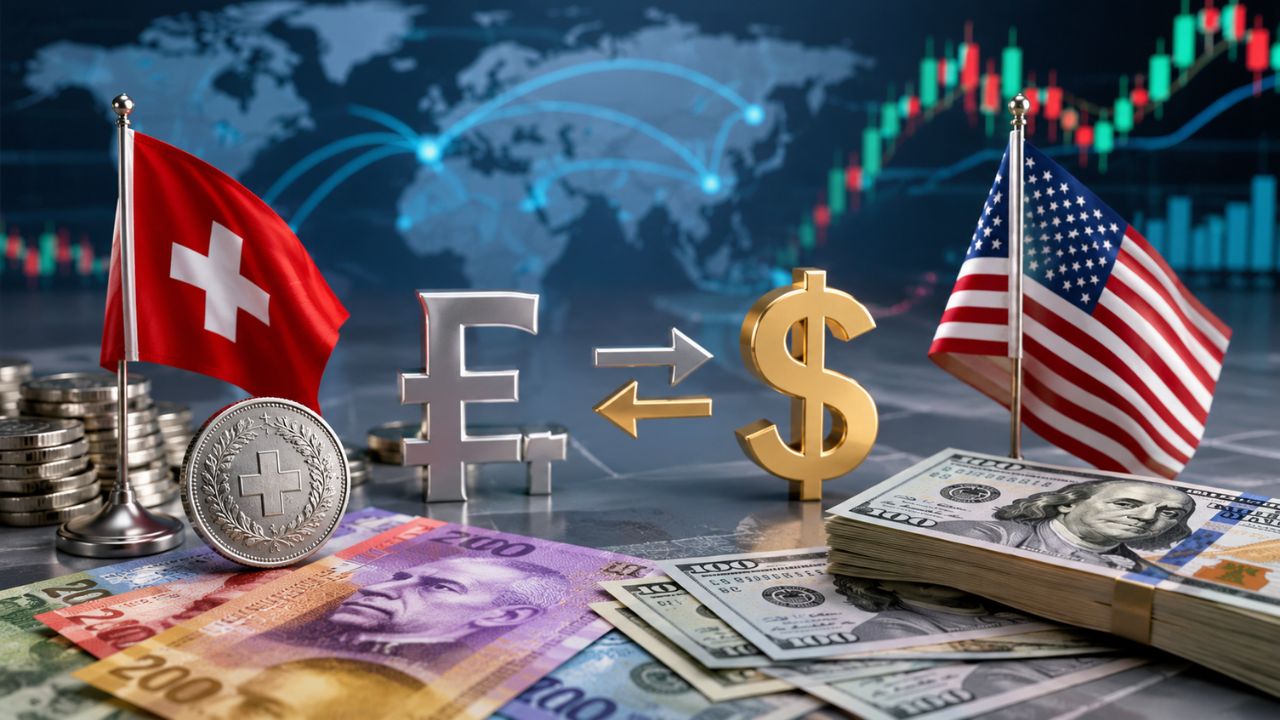
The answer to “what is switzerland currency” is the Swiss franc — code CHF, abbreviation Fr. or fr. It is the official legal tender of Switzerland and the tiny principality of Liechtenstein. It’s also used in Campione d’Italia, a small Italian enclave completely surrounded by Swiss territory.
The ISO code CHF stands for Confoederatio Helvetica Franc — the Latin name for the Swiss Confederation. You’ll see it on every currency converter, every forex platform, and every airport exchange board.
Key CHF Facts at a Glance
| Feature | Detail |
|---|---|
| Currency Name | Swiss Franc |
| ISO Code | CHF |
| Symbol | Fr. (German/Romansh), fr. (French/Italian) |
| Subdivisions | 100 centimes (or Rappen in German) |
| Banknotes | CHF 10, 20, 50, 100, 200, 1,000 |
| Coins | 5, 10, 20 centimes; ½, 1, 2, 5 franc |
| Issuer | Swiss National Bank (SNB) + Swissmint |
| Current Rate (Jun 2026) | 1 CHF ≈ 1.2323 USD |
| Rank by global trading volume | 7th most traded worldwide |
Switzerland is home to one of the most advanced economies on the planet, with GDP per capita ranking in the global top five. That economic foundation is what gives switzerland currency its lasting credibility.
A Brief History of the Swiss Franc — From 860 Coins to One Stable Currency
Here’s something most people don’t realize: before 1850, Switzerland had a genuinely chaotic monetary system. About 75 different entities — cantons, cities, abbeys — were each issuing their own coins. At one point, approximately 860 distinct types of coins were in circulation across the country.
That changed with the Federal Coinage Act of May 7, 1850, which unified all of Switzerland under a single monetary unit: the franc. It was introduced at par with the French money of the time — the French franc — which is why the two currencies share a name and part of their origin story.
Switzerland joined the Latin Monetary Union in 1865, alongside France, Belgium, and Italy, agreeing on a shared gold standard. That union eventually dissolved, but by then Switzerland had built the institutional foundations for one of the world’s most trusted currencies.
A few landmark moments worth knowing:
- 1945: Switzerland joined the Bretton Woods system, pegging the franc to the US dollar.
- 1971: Nixon ended dollar-gold convertibility. The franc began to float — and it appreciated sharply.
- 2011: The SNB shocked markets by introducing a currency floor of 1.20 CHF per euro, trying to prevent the franc from becoming too strong.
- 2015: The SNB abruptly abandoned that peg, sending shockwaves through forex markets. The franc surged nearly 30% against the euro in minutes.
- 2025–2026: A new wave of appreciation, with the CHF gaining roughly 12.7% against the dollar in 2025 alone, driven by global uncertainty and a weakening greenback.
The connection to french money is more than historical curiosity — it explains why Swiss monetary history is so intertwined with continental European financial systems, even as Switzerland itself stayed out of the EU and the eurozone.
Swiss Franc to USD: Live Rate and Recent History
Here’s the current picture, as of late June 2026:
- 1 CHF = approximately 1.2323 USD
- 1 USD = approximately 0.8115 CHF
- Over the past 12 months, the CHF/USD average has been around 1.2608
- The peak rate in the past year hit 1.3106 on January 27, 2026
- The lowest point was roughly 1.2280 in July 2025
Looking back at 2024, the average rate was 1.1363 CHF per dollar — meaning the franc has strengthened considerably since then. Over ten years, the franc has appreciated more than 25% against the dollar.
For travelers and businesses, this matters enormously. When fr to usd conversion gives you $1.23 for every franc, buying goods or services in Switzerland becomes quite expensive for anyone spending US dollars.
Why Has the Franc Strengthened So Much?
Three forces are driving this:
- Safe-haven demand. Every time markets get nervous — whether it’s geopolitical tension, US policy uncertainty, or financial stress — investors move money into Swiss francs. It’s a deeply rooted pattern.
- US dollar weakness. The dollar faced sustained pressure in 2025 due to trade policy uncertainty, questions about Federal Reserve independence, and slowing economic growth in the US.
- Switzerland’s structural trade surplus. Switzerland consistently exports more than it imports (pharmaceuticals, watches, precision instruments, gold refining). That surplus creates steady demand for francs in global currency markets, supporting the currency’s long-term appreciation trend.
Switzerland Currency to USD: How the Conversion Actually Works
When you convert switzerland currency to usd, you’re participating in the world’s most liquid market: foreign exchange (forex). The CHF/USD pair trades 24 hours a day, five days a week, from when Sydney opens on Monday morning to when New York closes on Friday afternoon.
The “exchange rate” you see quoted is typically the mid-market rate — the midpoint between the buy and sell prices that professional traders use. This is the rate you’ll see on tools like the OANDA currency converter or Google’s built-in converter. But it’s not usually the rate you’ll actually get.
Here’s how different platforms give you different rates:
Mid-Market Rate vs. What You’ll Actually Pay
| Source | Rate Type | Typical Cost to You |
|---|---|---|
| OANDA (interbank) | Mid-market | Reference rate only |
| Wise (TransferWise) | Mid-market + small fee | Transparent, usually cheapest |
| Visa exchange rate | Close to mid-market | 0–1% markup typically |
| Mastercard exchange rate | Close to mid-market | 0–1% markup typically |
| Bank wire transfer | Mid-market + spread | Often 2–4% above mid-market |
| Airport kiosk or hotel | Whatever they want | Can be 5–10% above fair rate |
The visa exchange rate and mastercard exchange rate are both competitive and worth using when traveling — they typically track close to the interbank mid-market rate and are much better than what you’d get at a physical exchange booth. Visa and Mastercard publish their daily rates on their respective websites, so you can check before you travel.
For larger transfers — say, paying a Geneva-based contractor or moving savings — the exchange rate differential matters a great deal. A 2% spread on $50,000 is $1,000 gone in fees.
The Best Currency Converter Tools for CHF/USD in 2026
If you need to convert francs to usd or the reverse, you have a lot of options. Here are the ones most worth using:
OANDA Currency Converter
OANDA is one of the oldest and most trusted names in forex. The oanda currency converter gives you live mid-market rates with historical data going back decades. It’s particularly useful if you want to check the exchange rate at a specific date in the past — valuable for accounting, expense reporting, or retrospective analysis.
OANDA also offers a rate API used by thousands of businesses to automate their currency calculations. If you’re running a company with cross-border payments, oanda is one of the most reliable reference points available.
Wise (formerly TransferWise)
Wise built its reputation on showing you exactly what you’re paying — the mid-market rate plus a transparent, low fee. For switzerland money to usd conversions, Wise consistently beats traditional banks on both rate and cost. The mobile app also shows a historical rate chart so you can see whether you’re converting at a good time.
Google Finance and XE.com
Quick and free. Type “francs to usd” or “swiss franc to usd” into Google and you’ll get a live converter right in the search results. XE.com goes deeper, offering rate alerts, historical charts, and multi-currency calculators.
Your Bank’s Currency Converter
Convenient but rarely the best rate. Most banks add a spread of 2–4% over mid-market. For small amounts, the convenience might be worth it. For anything significant, the spread adds up fast.
Finding Currency Exchange Near Me
If you need physical cash, look for currency exchange near me using Google Maps. In most major cities, independent exchange bureaus beat bank rates. Avoid airport exchanges if you can — the margins there are often brutal. If you’re traveling to Switzerland, withdrawing CHF directly from a Swiss ATM often gives you a rate close to interbank, especially if your card doesn’t charge foreign transaction fees.
How the Swiss National Bank Controls Switzerland’s Money
The Swiss National Bank (SNB) is Switzerland’s central bank — founded in 1907 and headquartered in both Bern and Zurich. Its current chairman is Martin Schlegel, who took over in October 2024 from Thomas Jordan.
The SNB has one primary mandate: price stability, defined as CPI inflation below 2% annually but above zero. In practice, Switzerland has maintained extraordinarily low inflation for decades — sometimes dipping close to zero or even negative.
The SNB’s current policy rate sits at 0.0% as of June 2026 — the only major central bank in the world currently holding a zero policy rate. That matters because:
- Low rates make CHF-denominated borrowing cheap, which can stimulate economic activity.
- But it also makes the franc less attractive to yield-seeking investors, putting slight downward pressure on the currency.
- The SNB has historically used negative rates and direct forex market intervention to try to weaken the franc when it appreciates too fast.
In June 2026, the SNB signaled greater readiness to intervene in currency markets if the franc strengthens too quickly — a recurring tool in their playbook. The bank holds enormous foreign currency reserves (one of the largest in the world relative to GDP) specifically to deploy in such situations.
For anyone tracking the switzerland currency to usd rate, watching SNB policy announcements is essential.
Switzerland Money to USD: Practical Conversion Examples
Let’s make this concrete. Here are real-world calculations using the current approximate rate of 1 CHF = 1.2323 USD:
| CHF Amount | USD Equivalent |
|---|---|
| 1 CHF | $1.23 |
| 10 CHF | $12.32 |
| 50 CHF | $61.62 |
| 100 CHF | $123.23 |
| 500 CHF | $616.15 |
| 1,000 CHF | $1,232.30 |
| 10,000 CHF | $12,323.00 |
| 100,000 CHF | $123,230.00 |
For the reverse — fr to usd direction flipped — 1 USD currently buys approximately 0.8115 CHF.
These figures change continuously throughout trading hours. If you’re executing a large transaction, even a few hours can make a meaningful difference. Setting a rate alert through your currency converter of choice is smart practice.
Euro to Pounds and Euro to USD: How CHF Fits Into European Currency Exchange
A quick side note for European travelers and investors: the Swiss franc is not the euro. Switzerland is not in the eurozone and has explicitly chosen to stay outside it. Swiss voters rejected EU membership in a 2001 referendum.
This means that if you’re doing a euro to pounds calculation or a euro to £ calculator search, you’re dealing with a completely different currency pair than CHF/USD or CHF/EUR.
The euro trades separately against the franc. As of mid-2026, 1 EUR buys approximately 0.92 CHF — meaning the franc has also strengthened significantly against the euro. In tourist areas, Swiss shops sometimes accept euros, but they give change in francs — often at an unfavorable rate for the traveler.
If your travel plans take you from the UK to Switzerland (or vice versa), you’ll be dealing with three currencies: pounds, euros, and francs. Using a good money converter that handles multiple currency pairs simultaneously — like XE or Wise — saves a lot of headache.
What Drives the CHF/USD Exchange Rate? Key Factors to Watch
The exchange rate between the Swiss franc and the US dollar doesn’t move randomly. Several factors consistently influence it:
1. Global Risk Sentiment
The franc is the world’s premier safe-haven currency (alongside the Japanese yen and gold). When investors get nervous — stock market crashes, geopolitical conflicts, banking crises — money flows into CHF. This drove significant appreciation in both 2025 and early 2026.
2. US Federal Reserve Policy
When the Fed raises rates aggressively, the dollar strengthens relative to most currencies including the franc. When the Fed signals cuts or pauses, the dollar weakens and CHF typically gains ground. Watching Fed meeting outcomes is directly relevant to fr to usd conversions.
3. Swiss National Bank Decisions
SNB rate decisions and currency intervention signals move the franc directly. Zero interest rates (as currently) reduce the “carry” of holding CHF but don’t stop the safe-haven appeal.
4. Switzerland’s Trade Balance
Switzerland runs a consistent export surplus. When Swiss pharmaceutical companies, watchmakers, and industrial manufacturers export goods, foreign buyers need to purchase Swiss francs to pay for them. That structural demand supports long-term CHF strength.
5. US Economic Data
Inflation figures, employment reports, and GDP growth in the US all affect the dollar component of swiss franc to usd. Strong US data tends to lift the dollar; weak data pushes it lower.
6. Inflation Differentials
Switzerland’s inflation rate is among the lowest in the developed world — currently forecast at around 0.6% for 2026. That means the franc preserves purchasing power better than most currencies, including the dollar, which has had higher inflation in recent years.
Cambio do Dia: What Non-English Speakers Need to Know
For Portuguese speakers and others who search for the daily rate using terms like cambio do dia, the concept is the same — you’re looking for today’s exchange rate. The mid-market CHF/USD rate updates in real time during trading hours, typically between 3 PM and 4 PM GMT when forex market liquidity peaks.
Multiple currency platforms offer their interfaces in different languages, and tools like OANDA, XE.com, and Wise all support international users looking up the daily rate for Swiss franc conversions.
Visa Exchange Rate vs. Mastercard Exchange Rate: Which Card Is Better in Switzerland?
If you’re traveling to Switzerland and planning to pay by card, this is a genuinely useful comparison.
Both visa exchange rate and mastercard exchange rate systems convert your purchases at daily rates that closely track the interbank mid-market rate. In practice, the difference between Visa and Mastercard currency conversion is usually less than 0.5% — not a meaningful factor for most travelers.
What matters more:
- Your card’s foreign transaction fee. Many travel credit cards have no foreign transaction fee. Standard cards often charge 1.5%–3%, which dwarfs any Visa vs. Mastercard difference.
- Whether the merchant or ATM offers “dynamic currency conversion.” If a Swiss merchant offers to charge you in dollars instead of francs, decline. That’s dynamic currency conversion, and it almost always uses a worse exchange rate than what your card would apply automatically.
- Which network has better acceptance. Both Visa and Mastercard are widely accepted across Switzerland.
For large purchases, both networks publish their conversion rates on their websites the day before the transaction settles. If you’re buying an expensive Swiss watch or piece of jewelry, check both visa exchange rate and mastercard exchange rate ahead of time to see which is more favorable.
Tips for Getting the Best CHF/USD Conversion
Whether you’re a traveler, a business, or an investor, here’s how to maximize the value when converting switzerland money to usd or the reverse:
1. Use the mid-market rate as your benchmark. Check OANDA or XE first. Any conversion you do should be compared against that baseline. The gap is your cost.
2. Avoid exchanging money at airports. Airport exchange booths typically have the widest spreads. Withdraw CHF from a Swiss ATM instead (your home bank’s international fee may be cheaper than the airport markup).
3. Consider a multi-currency account. Services like Wise, Revolut, or Airwallex let you hold CHF and USD separately and convert between them when rates are favorable.
4. Set rate alerts. Tools like XE, OANDA, and Wise all let you set alerts for when swiss franc to usd hits a specific level. If you’re not in a rush, patience pays.
5. Watch the calendar. SNB policy meetings, US Federal Reserve announcements, and major economic data releases (US CPI, Swiss GDP) all cause rate volatility. Converting immediately before a big announcement is a gamble.
6. Use your travel card wisely. Visa and Mastercard both give competitive rates. Just make sure your card doesn’t have foreign transaction fees.
7. For business payments, lock in with a forward contract. If you know you’ll need to pay a Swiss supplier in 60 days, a forward contract lets you lock in today’s rate through a service like OFX or MTFX, protecting you from adverse moves.
Frequently Asked Questions
What is the current swiss franc to usd exchange rate?
As of June 25, 2026, 1 Swiss franc equals approximately 1.2323 US dollars. The rate fluctuates continuously during market hours, so always check a live currency converter like OANDA, XE, or Google Finance for the most current figure before converting.
What is switzerland currency called?
The official switzerland currency is the Swiss franc, abbreviated CHF internationally and written as Fr. (German) or fr. (French). It is subdivided into 100 centimes or Rappen depending on language region.
Is the swiss franc stronger than the US dollar?
Yes, currently. One franc buys more than one dollar — specifically about $1.23 — making the franc the stronger currency. Over the past decade, the franc has appreciated more than 25% against the dollar.
What is the best currency converter for swiss franc to usd?
OANDA is widely regarded as one of the most accurate and trusted sources for mid-market rates. For actual transfers, Wise (formerly TransferWise) typically offers the best combination of rate and fees. Google Finance is useful for quick checks.
Does Switzerland use the euro?
No. Switzerland is not in the eurozone. The switzerland currency is the Swiss franc. Euros are accepted informally in some tourist areas, but the franc is the official legal tender and you’ll receive change in francs.
How do visa and mastercard exchange rates compare?
Both the visa exchange rate and the mastercard exchange rate track closely to the interbank mid-market rate. The difference between the two is typically under 0.5%, making your card’s foreign transaction fee a far more important factor than which network you use.
What is the connection between the swiss franc and french money?
When the Swiss franc was introduced in 1850, it was pegged at par with the french money of the time — the French franc — and both shared the same silver standard. Switzerland joined the Latin Monetary Union with France, Belgium, and Italy in 1865. The Swiss franc has since diverged significantly and has been fully independent of French monetary policy since the eurozone era.
What is “cambio do dia” in the context of Swiss francs?
Cambio do dia is Portuguese for “exchange rate of the day.” For Swiss franc to USD conversions, it refers to the current daily rate, which you can find on platforms like OANDA, Wise, or XE.
What time is best to convert swiss francs to usd?
Currency market liquidity is highest between 3 PM and 4 PM GMT, when European and North American trading sessions overlap. Converting during this window generally gives you rates closest to the true mid-market rate. Also, converting early in the week avoids delayed settlement that can happen with late-week transactions.
How does the oanda currency converter work?
The oanda currency converter shows you the mid-market exchange rate for any currency pair, including swiss franc to usd. You enter an amount, select your source and target currencies, and it displays both the converted value and the current rate. OANDA also offers historical rate lookups and a rate API for businesses needing automated data feeds.