
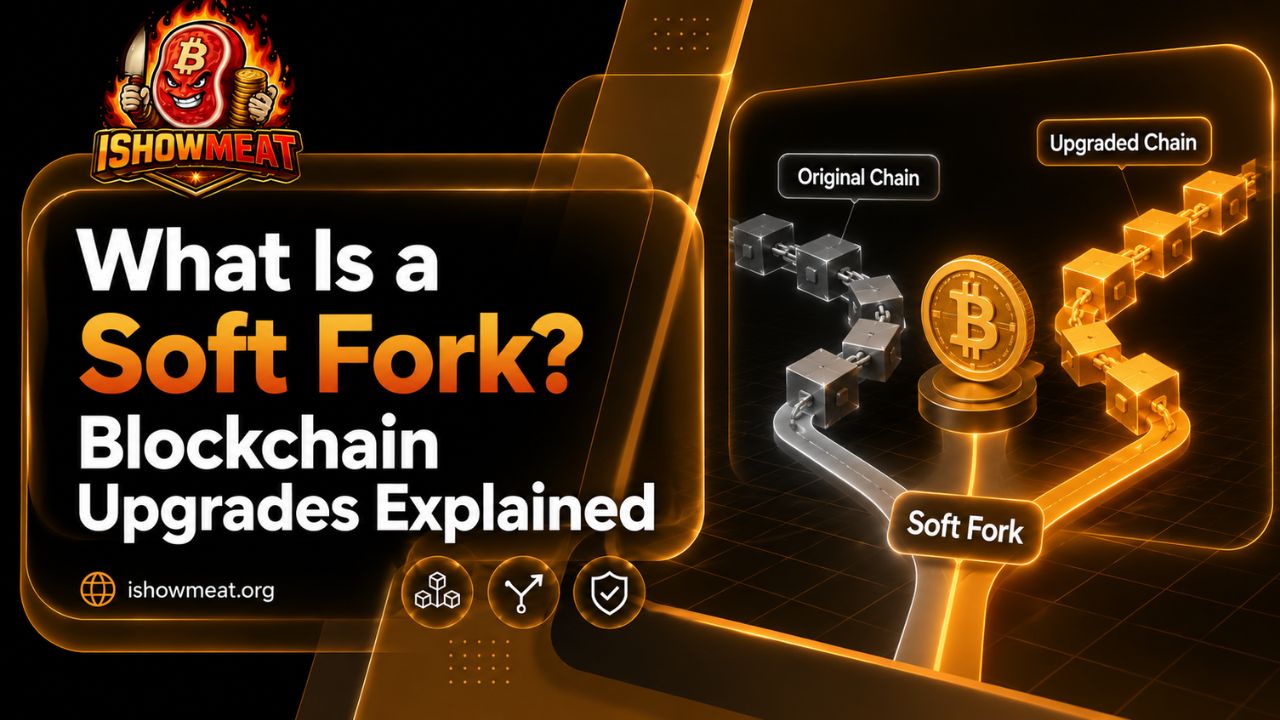
If you’ve spent any time reading about Bitcoin or Ethereum, you’ve probably run into the term “fork” and felt your eyes glaze over a little. Forks sound technical and a bit intimidating, but the core idea behind one type — the soft fork — is actually pretty simple once someone walks you through it without the jargon.
So, what is a soft fork? In short, a soft fork is a backward-compatible upgrade to a blockchain’s rules. Nodes that haven’t updated their software can still read and validate the new blocks, even though the rules have changed slightly. Nobody gets left behind, no new coin gets created, and the network stays in one piece.
That’s the textbook answer. But the real story — why developers choose soft forks, how they’ve shaped Bitcoin’s history, and where things can go sideways — is far more interesting. Let’s get into it.
Quick Answer: Soft Fork in One Sentence
A soft fork tightens or adjusts a blockchain’s consensus rules in a way that old, non-upgraded nodes still consider valid, which keeps the entire network on a single chain instead of splitting it into two.
That’s the version you’d want if Google decided to feature this answer in a snippet box. Now let’s unpack what that actually means in practice, because the one-liner only gets you halfway there.
Why This Topic Matters Right Now
Anyone holding crypto, running a node, building on a blockchain, or just trying to sound informed at a dinner party has bumped into fork terminology. Bitcoin alone has gone through dozens of proposed and activated soft forks since 2012, and each one quietly reshaped how the network behaves — often without most users noticing at all. Understanding soft forks gives you a much clearer picture of how decentralized networks evolve without a CEO pushing an update button.

How a Soft Fork Actually Works
Picture a shared rulebook that every computer (node) on a network agrees to follow. A soft fork doesn’t rewrite that rulebook from scratch — it narrows it. Imagine the old rule said “any block under 2MB is valid,” and the new rule says “any block under 1MB is valid.” Every block that satisfies the new, stricter rule also satisfies the old one. Old nodes look at the new blocks and think, “Yep, that checks out,” even though they don’t fully understand the newer features layered on top.
This is the defining trait of a soft fork: new rules are a subset of old rules. Anything valid under the new rules is automatically valid under the old ones, but not necessarily the other way around.
Compare that to a hard fork, where the rules change in a way that’s not backward compatible. Old nodes reject new blocks outright, which can split the network into two separate chains with two separate histories — and sometimes, two separate coins.
A Simple Analogy
Think of a soft fork like a building updating its fire code so that new construction must use safer materials. Older buildings that don’t meet the new standard are still allowed to stand — they’re “grandfathered in.” Nobody has to tear down their house. A hard fork, on the other hand, is more like the city saying old buildings are no longer legal at all, forcing a choice: rebuild, or split off into your own separate town with the old rules.
Soft Fork vs Hard Fork: The Side-by-Side Comparison
| Feature | Soft Fork | Hard Fork |
|---|---|---|
| Backward compatible | Yes | No |
| Old nodes can validate new blocks | Yes | No |
| Risk of chain split | Low | High |
| Requires near-universal upgrade | No | Yes |
| Creates new cryptocurrency | Rarely | Sometimes |
| Example | Segregated Witness (SegWit) | Bitcoin Cash split from Bitcoin |
| Typical use case | Tightening rules, adding features | Major protocol overhaul |
| Coordination difficulty | Lower | Higher |
This table is the kind of thing people screenshot and save, so it’s worth committing the main row — backward compatibility — to memory. That single distinction explains almost everything else in the chart.
Real-World Examples of Soft Forks
Theory is fine, but examples are what make this stick.
Segregated Witness (SegWit) — Bitcoin, 2017
SegWit is probably the most famous soft fork in crypto history. It restructured how transaction data was stored, separating the signature data (“witness” data) from the rest of the transaction. This freed up effective block space and fixed a long-standing bug called transaction malleability. Old nodes that hadn’t upgraded still saw SegWit transactions as valid — they just interpreted them slightly differently, treating the witness data as “anyone can spend” data that miners had already verified.
BIP 66 — Strict DER Signatures
This one tightened the rules around how digital signatures had to be formatted. It sounds dry, but it closed a security loophole that could have been exploited. Old nodes still accepted the new, stricter blocks because the new format was a subset of what was already allowed.
P2SH (Pay-to-Script-Hash)
Implemented back in 2012, this soft fork let Bitcoin support more complex transaction types — like multi-signature wallets — without forcing every node to understand the full complexity of the underlying script. It just looked like a normal payment to a script hash from the outside.
Taproot — Bitcoin, 2021
Taproot bundled several upgrades (Schnorr signatures, MAST, and Tapscript) into a single soft fork that improved privacy and efficiency for complex transactions, particularly multi-signature and smart-contract-like setups, while still looking like an ordinary transaction to non-upgraded nodes.
How Soft Forks Get Activated
A soft fork doesn’t just flip on overnight. Developers propose it, often as a Bitcoin Improvement Proposal (BIP) or an equivalent on other chains, and then the network has to agree to actually use it. There are a few common activation methods:
- Miner signaling (BIP 9): Miners include a flag in blocks signaling readiness; once a threshold (often 95%) is hit within a time window, the rule activates.
- User-activated soft fork (UASF): Instead of waiting on miners, node operators and businesses agree to enforce the new rule by a set date, pressuring miners to follow along or risk having their blocks rejected.
- Speedy Trial: A faster signaling method used for Taproot, designed to avoid the stalling that happened with SegWit’s original activation attempt.
The SegWit rollout is a great case study here because it wasn’t smooth. Miner signaling stalled for months, which eventually led to the User-Activated Soft Fork movement — a moment where regular node operators essentially told miners, “Upgrade, or we’ll stop accepting your blocks.” That pressure worked, and SegWit activated in August 2017.
Why Developers Prefer Soft Forks When Possible
If you’re a protocol developer, a soft fork is generally the lower-risk, lower-drama path. Here’s why teams reach for it first:
- No chain split risk. Everyone stays on one chain, which avoids the confusion (and market chaos) of two competing versions of the same coin.
- Gradual adoption. Nodes can upgrade on their own timeline instead of facing a hard deadline.
- Lower coordination cost. You don’t need every single participant to flip a switch at the same moment.
- Preserves network value and trust. Splitting a chain dilutes brand identity, confuses users, and can tank confidence in the project.
That said, soft forks aren’t a free lunch. They’re more constrained — you can only tighten rules, not loosen them or add features that fundamentally contradict the old rulebook. Some upgrades genuinely require a hard fork because the change is too fundamental to squeeze into the “old nodes still approve” box.
The Trade-Offs Nobody Talks About Enough
Most explainers stop at “soft forks are safer,” but there’s nuance worth knowing if you actually want to understand this topic at a deeper level.
Old Nodes Lose Visibility, Not Just Compatibility
Just because an old node accepts a soft-forked block doesn’t mean it fully understands what’s happening inside it. With SegWit, for example, non-upgraded nodes could validate blocks but couldn’t independently verify the witness data — they were trusting that miners had already checked it. This is sometimes called a reduction in “full validation,” and it’s a real, if subtle, security trade-off.
Miner Power Can Become a Bottleneck
Because some activation methods rely on miner signaling, a soft fork’s fate can get stuck in the hands of a relatively small group of mining pools. That’s exactly what happened during the SegWit standoff, and it’s part of why the UASF movement existed in the first place — to take some of that leverage away from miners.
“Soft” Doesn’t Mean “Minor”
People sometimes assume soft forks are small, cosmetic tweaks. Taproot proves that wrong — it was a major architectural shift that touched privacy, scripting, and signature schemes, all while staying backward compatible. The “soft” in soft fork refers to the compatibility mechanism, not the size of the change.
How This Plays Out Beyond Bitcoin
Bitcoin gets most of the attention because of BIP 9, UASF, and SegWit drama, but soft forks aren’t unique to it. Ethereum, Litecoin, and other proof-of-work and proof-of-stake chains have used similar backward-compatible upgrade patterns, even if they don’t always use the exact term “soft fork.” The underlying principle — tightening validation rules so old software still agrees with new blocks — shows up across the blockchain ecosystem, including projects built with tools like Bitcoin Core, and discussed extensively on platforms like GitHub and in BIP repositories where developers debate and document proposed changes.
A Practical Way to Spot a Soft Fork in the Wild
Next time you read about a blockchain upgrade, ask yourself two questions:
- Do nodes that skip the upgrade still accept the new blocks as valid?
- Could the network split into two separate chains if adoption is uneven?
If the answer is “yes” to the first question and “no” to the second, you’re almost certainly looking at a soft fork. If it’s the reverse, you’re looking at a hard fork.
Common Misconceptions About Soft Forks
- “A soft fork always needs 100% agreement.” Not true — it needs enough of the network (often miners, sometimes node operators) to enforce the new rule, but stragglers aren’t forced off the chain.
- “Soft forks can’t add new features.” They absolutely can, as Taproot and SegWit both show — they just have to do it within the backward-compatible constraint.
- “A soft fork is risk-free.” It reduces the risk of a chain split, but coordination failures, stalled signaling, and reduced validation transparency are all real risks that have played out historically.
FAQ: What Is a Soft Fork?
Is a soft fork reversible? Generally yes, in the sense that it doesn’t split the chain, so the network can continue adjusting rules in future upgrades without the baggage of two separate coin histories.
Does a soft fork create a new cryptocurrency? No. Unlike a contentious hard fork, a soft fork keeps everyone on the same chain with the same coin, since old nodes still validate the new blocks.
What’s the biggest soft fork in Bitcoin’s history? SegWit and Taproot are usually considered the two biggest, given how much they changed about transaction structure and signature schemes while staying backward compatible.
Can a soft fork fail? Yes. If it doesn’t get enough signaling or support, it simply doesn’t activate, and the network continues under the existing rules — no harm done, just no upgrade.
Who decides whether a soft fork happens? It’s a mix of developers proposing the change (often through a BIP), miners or node operators signaling support, and the broader community choosing to run the updated software.
Is a soft fork the same as a protocol update? A soft fork is one type of protocol update — specifically, one designed to be backward compatible. Not every protocol update is a soft fork, since some require a hard fork instead.
Wrapping It Up
A soft fork is one of the more elegant solutions in blockchain engineering: a way to improve, tighten, or extend a network’s rules without forcing everyone to upgrade at gunpoint or risking a chain split. SegWit, P2SH, BIP 66, and Taproot all show that “backward compatible” doesn’t mean “small” — some of the most consequential upgrades in Bitcoin’s history have come through this exact mechanism.
If you walk away from this with one thing, let it be this: a soft fork narrows the rules so tightly that old nodes still nod along, even when they can’t see the full picture of what’s new. That’s the quiet genius behind it.